PC (Microsoft Windows)2016
Puzzle Cube
Three in a row, but in 3d!
Screenshots
578
Mostly Positive
4 Steam reviews
Review History
| LANGUAGE | AUDIO | SUBTITLES | INTERFACE |
|---|---|---|---|
| English | — | — | Y |
Three in a row, but in 3d!
Mostly Positive
4 Steam reviews
| LANGUAGE | AUDIO | SUBTITLES | INTERFACE |
|---|---|---|---|
| English | — | — | Y |
паззлики
Puzzle Cube, developed by ThinkOfGames and published by Conglomerate 5, is a minimalist 3D puzzle game that takes the familiar concept of color-matching and reimagines it within a spatial framework. Rather than relying on the fast-paced, arcade-like energy of most match-based games, Puzzle Cube offers a slower, more methodical experience that rewards careful planning and foresight. It’s a game built on simple mechanics but designed to challenge the player’s sense of spatial reasoning, requiring not only attention to detail but also the ability to think several moves ahead. What begins as a straightforward exercise in matching colors soon reveals itself as a clever and occasionally deceptive mental workout wrapped in a clean, uncluttered presentation.
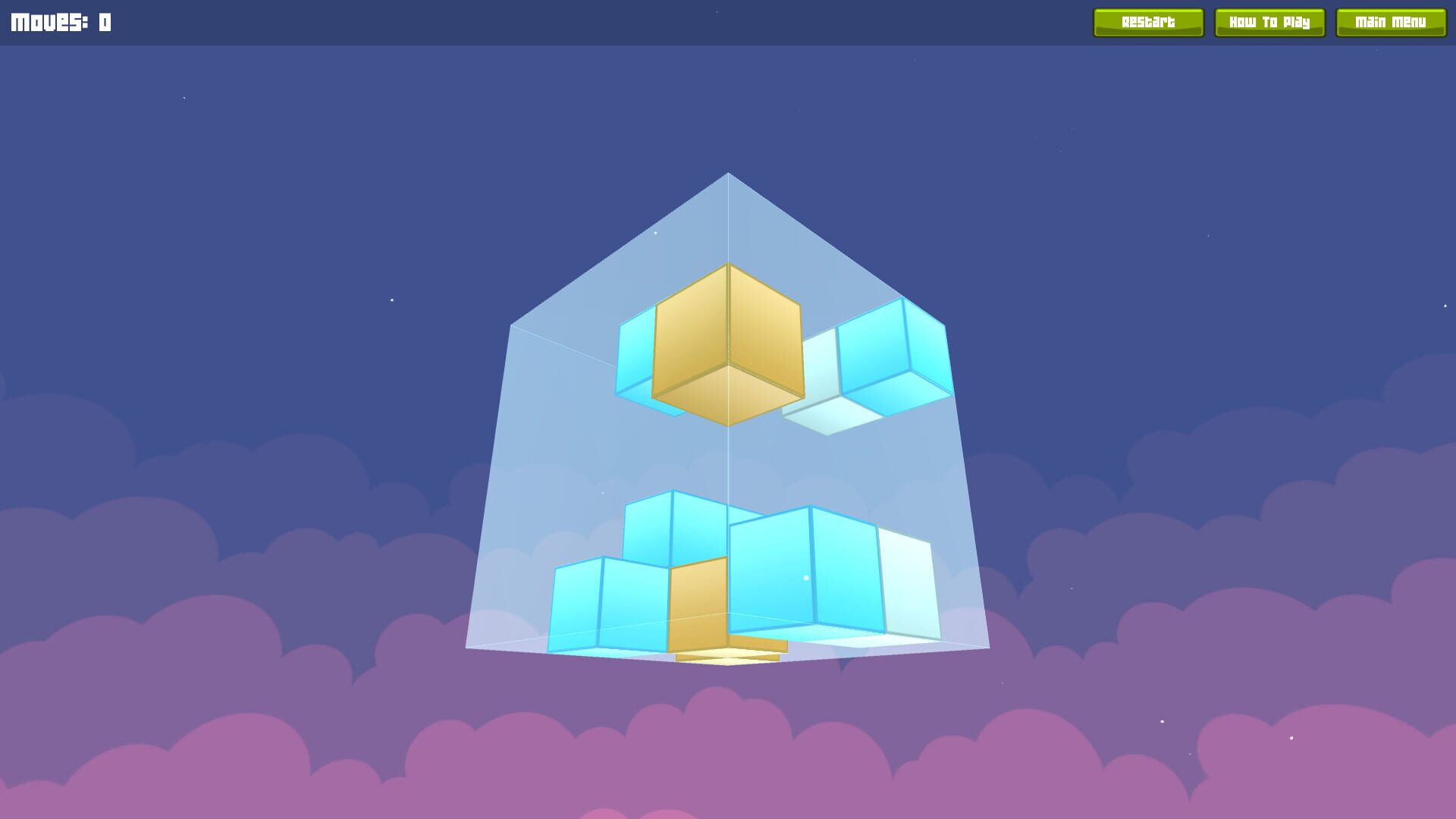
The core gameplay revolves around manipulating colored cubes within a 3D grid. The player can slide cubes toward any of the six boundaries—up, down, left, right, forward, or backward—with the goal of lining up three or more cubes of the same color to make them disappear. Each move alters the position of multiple cubes, forcing the player to anticipate how the board will change with every action. While the basic rule is easy to grasp, mastering the system is far from simple. Some levels feature frozen cubes that must be unlocked before use, while others introduce explosive cubes that can clear surrounding tiles, creating a chain reaction. The mechanics strike a balance between accessibility and depth: anyone can pick up the controls quickly, but completing later levels often requires meticulous observation and a willingness to experiment with unconventional moves.
The design philosophy behind Puzzle Cube is one of restraint. It doesn’t bombard the player with flashy effects, dialogue, or timers. Instead, the focus is on clarity and concentration. Each of the 120 handcrafted levels presents a self-contained challenge, steadily increasing in complexity as new cube types and layouts are introduced. The gradual escalation ensures that players are never overwhelmed, yet the simplicity of the interface allows them to remain focused on problem-solving rather than on extraneous mechanics. The game’s interface is intuitive, the camera system works smoothly, and the lack of distractions—no ads, pop-ups, or unnecessary UI clutter—makes it easy to slip into a state of flow. The puzzles themselves are well-constructed, and there’s a satisfying rhythm that develops as you slide cubes, watch lines disappear, and consider your next move.
Visually, the game’s aesthetic is understated but effective. The environments are minimalistic, consisting mostly of solid colors, clean lines, and soft lighting. This simplicity keeps attention on the puzzles themselves, but it also gives the game a sense of elegance. Each cube is distinct enough to read easily, and the visual clarity ensures that even complex configurations remain legible. The soundtrack follows a similar philosophy, offering calm, ambient background music that enhances focus rather than distracts from it. Together, these elements create a meditative atmosphere that encourages careful thought and experimentation. While some may find the visuals too plain or the sound design too subtle, others will appreciate how these choices contribute to the game’s relaxing and cerebral tone.
Where Puzzle Cube stumbles slightly is in variety and pacing. The mechanics, while strong, do not evolve much beyond the core concept of matching and clearing cubes. After a few dozen levels, players may begin to feel a sense of repetition as strategies start to overlap. The introduction of new block types adds some variation, but the overall rhythm of play remains largely consistent. Because of this, the game works best in short sessions rather than marathon playthroughs. There’s also an element of trial and error in some stages, where solving a puzzle requires more guesswork than logic. The lack of features such as an undo button or multiple objectives per level can make these moments feel rigid. Still, these limitations are minor within the game’s intended scope, and the simplicity that might frustrate some players is the same quality that makes it easy to return to casually over time.
From a technical standpoint, Puzzle Cube runs exceptionally smoothly. Its modest requirements make it accessible even on older systems, and its lightweight design ensures quick load times and minimal bugs. The controls are responsive and easy to grasp, and the cube movement animations maintain a sense of weight and consistency that feels satisfying. It’s a small but well-optimized title that never overstays its welcome, offering exactly what it promises: a collection of short, polished logic puzzles for those who enjoy thinking spatially. The low price point only adds to its appeal, making it an affordable option for fans of brain teasers or anyone seeking a mental cooldown between more demanding games.
Puzzle Cube ultimately succeeds because it understands its identity. It doesn’t try to compete with larger, more elaborate puzzle games that rely on storytelling or constant novelty. Instead, it refines a single idea to near-perfection, delivering a focused and relaxing experience built on clarity, logic, and incremental challenge. Its 3D mechanics set it apart from typical grid-based puzzles, and while it may not innovate enough to sustain long-term engagement, it provides a satisfying and meditative experience for players who enjoy precise, structured problem-solving. For fans of minimalist puzzle design, it’s a refreshing reminder that complexity doesn’t always require extravagance—sometimes, the most engaging puzzles are those that test patience and perception in equal measure.
Rating: 7/10
[h3] En bref [/h3]
Ce jeu ressemble plus à un prototype qu'un produit fini. Le concept est intéressant, mais pas du tout affiné
[h3] Points forts / Points faibles [/h3]
- Seule la mécanique de gameplay est exploité, sans variation, sans finition, sans équilibrage
- Softlock quasi systématique dès la deuxième moitié du jeu
- Plusieurs bugs forçant la remise à zéro (cumulé au softlock, c'est extrêmement frustrant de jouer)
- Mécanique de gameplay unique à exploiter
- Interface claire et épurée (peut-être un peu trop ?)
- Tourne sur un grille-pain sans difficulté
[h3] Contexte [/h3]
J'aime les puzzle game. J'essaye de prendre le temps d'en tester beaucoup (et surtout des petits comme ceux-là). Je reconnait volontier la mécanique très intéressante. Mais celle-ci est clairement sous exploitée. L'interface est simple certes, mais il manque des informations. Une fois passé les premiers "groupes" qui sont plutôt intéressant, le jeu ne se renouvelle que par l'augmentation de la zone de jeu. Jusqu'à arriver à une taille absurde qui fait basculer le jeu dans un état "injouable". Je n'ai pris aucun plaisir à faire les 4~5 derniers groupes -> la moindre combinaison de 4 / 5 cubes d'une même couleur softlock le niveau. À ça, on ajouté la taille du niveau qui rend quasiment impossible la projection mentale de ce que va provoquer notre action. Le gameplay ne se diversifie plus après l'introduction des bombes (clairement inutile) et le manque de retour nous oblige à continuellement recompter les cubes pour vérifier si on est pas entrain de perdre son temps
Je ne peux pas recommander ce jeu, même si je salue la tentative
I liked cubes and tetris. It doesn't seem easy. I recommend it.